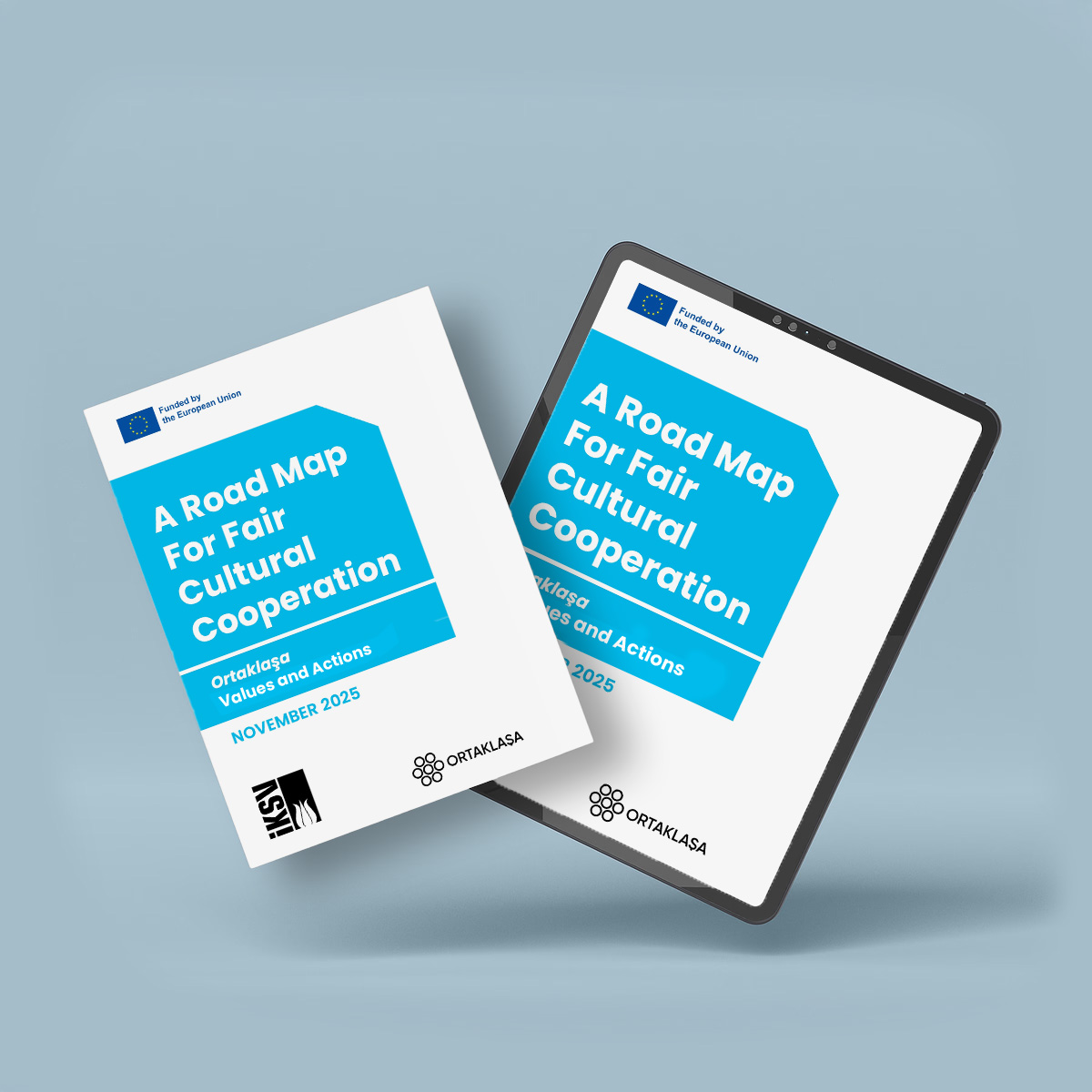
The policy paper “A Road Map for Fair Cultural Cooperation: Ortaklaşa Values and Actions” was prepared within the scope of the Ortaklaşa: Culture, Dialogue and Support Programme. Authored by Prof. Dr. Füsun Üstel, the document draws on Ortaklaşa’s three-year experience and offers principles, mechanisms, and concrete proposals to strengthen fair, participatory, and inclusive cooperation between municipalities and arts and culture civil society organisations (CSOs) in Türkiye.
The policy paper underlines that, in a period marked by the narrowing of artistic freedom of expression, increased political intervention in the cultural field, and the weakening of institutional capacity and financial resources at the local level, the democratisation of arts and culture can only be achieved through fair cultural cooperation.
Within Ortaklaşa, fair cultural cooperation is defined not merely as a set of result-oriented mechanisms or actions, but as a rights-based, dynamic, and open-ended process involving multiple actors. In this framework, three minimum and fundamental objectives are highlighted as essential to the realisation of fair cultural cooperation: access, inclusion, and participation.
The policy paper also identifies the structural obstacles that hinder fair cooperation. Long-standing fragilities in state–CSO relations in Türkiye, which are shaped by centralised governance, interruptions in democracy and freedom of expression, and an inadequate legal framework, have eroded trust between municipalities and CSOs. This environment often leads to cooperation being shaped by political proximity rather than public interest, affecting all actors within the local cultural ecosystem, from elected officials and municipal staff to artists and city residents.
The experiences of the 13 projects implemented under the Ortaklaşa Sub-grant Programme demonstrate that more fair, participatory, and inclusive forms of cooperation in arts and culture are possible. These projects, which operated across four interrelated fields of action—building spaces, organising events, community-building, and policymaking—form the empirical backbone of the policy paper.
Building on this accumulated experience, the policy paper puts forward concrete recommendations addressed to municipalities and all actors within the arts and culture ecosystem. These include proposals for new institutional arrangements and the strengthening of existing structures, continuous capacity-building and training programmes, comprehensive cultural mapping and inventories, cooperation-based project competitions, transparent and participatory funding models for the cultural field, and enhanced communication support mechanisms to increase the visibility of cultural production and collaboration.
Together, these proposals aim to ensure that fair cultural cooperation becomes a sustainable and integral component of local democracy and cultural policy in Türkiye.
a. Establishing a Municipality–CSO Cooperation Office and introducing the necessary legislative regulations to ensure its institutional and sustainable functioning.
b. Establishing Specialised Commissions on Arts and Culture within municipalities and guaranteeing the participation of CSO representatives in these commissions.
c. Transforming public properties into arts and culture-oriented public service spaces without privatisation; ensuring that expert opinions are taken into account when existing spaces are refunctioned for arts and culture purposes.
d. Allocating working and meeting spaces for CSOs to support their organisational capacity and sustainability.
e. Establishing digital platforms that enable CSOs to act collectively, facilitating cooperation, information sharing, and joint initiatives.
f. Strengthening the role of City Councils by enhancing their functions in governance processes, participation, checks and balances, and collective decision-making.
g. Reinforcing the place of arts and culture in strategic plans by prioritising public benefit and integrating culture into public planning processes through a strategic and holistic approach; ensuring the inclusion of concrete mechanisms that support cooperation.
a. Providing regular in-service trainings for all municipal units engaged with arts and culture; ensuring that municipal unions (e.g. the Marmara Municipalities Union) assume a coordinating role in this process; and establishing a free, certified training portal in cooperation with municipalities and universities.
b. Organising regular participatory workshops with different communities (such as women, young people, persons with disabilities, etc.), systematically recording the outcomes of these workshops, and integrating them into cultural policy-making processes.
Establishing a comprehensive cultural inventory that includes physical spaces, institutions, research, and archives; ensuring that the inventory is continuously updateable; and forming planning agency working groups capable of producing data on cultural participation, cultural employment, and the economic contribution of culture.
Organising project competitions based on a blind peer-review system by municipalities; providing project-writing trainings for CSOs prior to the competitions; and holding regular project camps to develop cooperation opportunities among stakeholders.
Introducing legislative regulations to establish public–private sector cooperation funds; enabling public resources allocated to arts and culture projects to be accessed by non-profit organisations and artist initiatives through auditable and transparent mechanisms instead of tender-based procedures; and designing local funding models based on transparency, accountability, and participation.
Allocating municipal communication channels (such as public transport screens, billboards, overpasses, etc.) free of charge to cultural institutions and artists in order to increase visibility and public access to cultural production.
Prof. Dr. Füsun Üstel attended the Notre Dame de Sion French High School for Girls and graduated from the Faculty of Political Sciences at Ankara University. In 1982 she became a research fellow at the Department of International Relations of the Faculty of Economics at İstanbul University. She received her doctorate from the Faculty of Political Sciences at Ankara University with her thesis titled “Türk Ocakları (1912-1931)” [Turkish Hearths]. She worked as faculty member in the Department of Public Administration (French) at Marmara University and the Department of Political Science at Galatasaray University, where she also served as department chair. She worked on the Advisory Board of İKSV’s Thread of Culture project. She retired in 2017.
She is the author of İmparatorluktan Ulus-Devlete Türk Milliyetçiliği: Türk Ocakları (1912-1931) [Turkish Nationalism from Empire to Nation-State: Turkish Hearths] (İstanbul: İletişim Yayınları, 1997); Yurttaşlık ve Demokrasi [Citizenship and Democracy] (Ankara: Dost Kitabevi, 1999); “Makbul Vatandaş”ın Peşinde: II. Meşrutiyet’ten Bugüne Vatandaşlık Eğitimi [In Pursuit of the “Acceptable Citizen”: Civic Education from the Second Constitutional Era to Present] (İletişim Yayınları, 2004); Eleştirel Düşünme [Critical Thinking] (with İpek Gürkaynak and Sami Gülgöz) (Education Reform Initiative, 2003); Türkiye’de Ermeniler: Cemaat, Birey, Yurttaş [Armenians in Türkiye: Community, Individual, Citizen] (with Günay Göksu Özdoğan, Ferhat Kentel, and Karin Karakaşlı) (İstanbul: İstanbul Bilgi Üniversitesi Yayınları, 2009); Kültür Politikasına Giriş: Kavramlar, Modeller, Tartışmalar [Introduction to Cultural Policy: Concepts, Models, Discussions] (İstanbul: İletişim Yayınları, 2021) as well as numerous articles on nationalism, citizenship, and cultural policy published in national and international social science journals.
For her work titled “Makbul Vatandaş”ın Peşinde: II. Meşrutiyet’ten Bugüne Vatandaşlık Eğitimi, she received the Afet İnan History Studies Award and the Notre Dame de Sion Alumni Association’s Achievement Award in 2004 followed by the Mülkiye Grand Prize in 2018.